Duplicate Data Is Costing You Growth

If you’ve ever looked at your daily conversions and wondered why every platform insists it was responsible for more than its share, you’re not imagining things.

You saw 1,000 orders.
Meta reports 2,000.
Google says 1,500.
Your internal spreadsheet tells another story entirely.

Now your team is stuck trying to reconcile conflicting data in a 12-tab Excel file—again.

This isn’t just an operational headache.
It’s a strategic liability.

The High Price of Conflicting Metrics

Duplicate data does more than create confusion. It:

  • Inflates perceived performance
  • Obscures the truth behind what’s really working
  • Leads to poor budget decisions
  • Erodes trust between marketing and finance

And the most expensive cost of all?
Time.

Hours lost manually cleaning up reports is time not spent optimizing strategy, improving creative, or increasing ROI.

The Spreadsheet Is Not a Strategy

We’ve seen the default fix:
Build massive Excel models.
Apply arbitrary discounting across platforms.
Hope it gets close enough for the next exec review.

But this approach is outdated.
It’s reactive, error-prone, and impossible to scale.
It traps your best people in data reconciliation instead of revenue-driving decisions.

There’s a Better Way Forward

At Provalytics, we’ve developed a platform that eliminates the duplication problem at the source—without relying on user-level tracking or cookies.

Instead of forcing you to manually clean up after each platform’s inflated attribution claims, our system creates a single, consistent, and validated view of marketing performance.

We automatically:

  • De-duplicate conversions across all channels
  • Measure true incrementality (what actually drove lift)
  • Provide predictive insights from Meta to TV and everywhere in between

The result?
One shared version of the truth—used by every team in the org, from hands-on-keyboard media buyers to CMOs and CFOs.

Aligning Marketing and Finance

When data is inconsistent, marketing and finance operate on separate narratives.
When it’s unified, they work from the same playbook.

With Provalytics, your finance team sees clearly what’s driving ROI.
Your marketing team knows where to scale.
And your leadership can make budget decisions with full confidence.

Let Your Team Focus on Strategy, Not Spreadsheets

Your analysts weren’t hired to be data janitors.
They should be testing new channels, uncovering insights, and driving performance—not chasing down conflicting numbers.

With Provalytics, you free your team from manual reporting and give them a powerful measurement framework designed for today’s fragmented, privacy-first marketing landscape.

đź’ˇ It’s time to replace complexity with clarity.

Let Provalytics unify your performance data so you can stop cleaning and start scaling.

Marketing Truths: No Belief, Just Data

Your boss loves the campaign.
It was filmed beautifully, the creative team is proud, and leadership is convinced it’s a winner.

But… it’s not working.

That awkward pause after the results roll in? That moment where no one wants to admit the truth? We’ve all been there.

In marketing, belief often overrides data. People get emotionally attached to creative ideas, certain channels, or tactics. But **the numbers don’t lie—**and more importantly, they don’t care who’s attached to what.

At Provalytics, we’ve spent nearly two decades living in this tension—between what stakeholders hope is working, and what actually is. And we’ve seen one consistent pattern: when reality doesn’t match belief, the blame falls on the measurement.

“It must be the model. The measurement’s off. There’s no way this campaign underperformed.”

But the uncomfortable truth is: it might not be the measurement. It might just be… the campaign.

Provalytics: Switzerland for Your Strategy

This is why we built Provalytics—to be the Switzerland of marketing measurement: neutral, unbiased, and driven by advanced math, not internal bias.

Our AI-powered platform ingests aggregated marketing and conversion data—no cookies, no user-level tracking, no personally identifiable data—and turns it into a clear, actionable performance view.

You’ll know exactly:

  • Which channels are really driving ROI
  • What creative is under- or over-performing
  • Which tactics are burning budget
  • And where to invest next, confidently

Our role isn’t to cheerlead your favorite campaign. It’s to surface what’s really working—so you can make better, faster, smarter decisions.

Belief is Powerful. But Truth Wins.

We get it. No one wants to tell the CMO their favorite idea flopped. But marketing success isn’t about validating egos. It’s about learning fast and optimizing faster.

Provalytics gives you the tools to do that, without finger-pointing, without subjective guesswork, and without needing invasive tracking.

When you measure performance objectively:

  • You can defend your strategy with clarity
  • You avoid costly misallocations
  • You grow faster, leaner, and smarter

It’s not always easy to challenge belief. But that’s where real marketing growth happens.

Get to Neutral. Get to Truth.

If your organization is stuck debating results, tied to assumptions, or unsure where to invest next, it’s time to bring in a neutral lens.

At Provalytics, we provide a single source of truth—one that brings everyone to the same page with data that’s clear, privacy-safe, and rooted in reality.

Because the only thing better than being right… is knowing for sure.

Ready to see what’s really working?
Discover how our platform removes bias, elevates strategy, and empowers performance.

Trust in Attribution Begins with Action

Marketing teams often rely on attribution models to guide decisions—but here’s the catch: a model only proves its value when you’re willing to follow its lead.

Imagine your attribution system suggests reducing spend on a channel you’re convinced is working. Would you listen? Or would you stick with your gut?

This hesitation highlights a deeper issue in measurement strategy: we say we want data-driven decisions—but only when the data tells us what we already believe.

Attribution Isn’t Just a Mirror—It’s a Forecast

Too often, attribution is treated as a post-mortem—a way to evaluate what’s already happened. But its real strength lies in its ability to guide future actions. The most powerful attribution models don’t just explain results; they predict what will happen if you adjust spend, shift strategy, or rebalance channels.

Of course, no model is infallible. But if it’s built correctly and consistently validated, it becomes a reliable compass—one worth following.

The challenge? Most teams aren’t testing whether the model actually works. They’re running reports, sharing insights, but rarely taking that next step: implementation.

Why Model Validation Matters

The only way to confirm whether an attribution model is accurate is to test its predictions in-market. That means taking action—based on what the model recommends—and measuring the results.

But before taking that leap, marketers need to know the model can be trusted. That’s where predictive validation techniques like K-Fold Cross-Validation come in.

In this approach:

  • The data is split into several segments.
  • A model is trained on part of the data and tested against a section that was left out.
  • This process is repeated multiple times, each with a different set of data held back.
  • The model’s performance is measured based on how accurately it predicted unseen data.

When done correctly, this process shows how consistently a model can forecast real outcomes. If the accuracy rate holds between 80% and 95%, that’s a strong signal you’re working with a dependable system—not just a statistical echo chamber.

From Confidence to Execution

Trust isn’t built overnight. But with proper validation in place, a model can earn its seat at the table. And once that trust is in place, marketing decisions become clearer, faster, and more aligned with outcomes.

If your measurement system is guiding you toward strategic shifts, and you’ve validated its predictive strength, the next logical step is to act.

That may mean reallocating spend, testing cuts in areas previously assumed to be top-performers, or doubling down where the model sees opportunity. It may be uncomfortable—but that’s often where the biggest breakthroughs happen.

Insight Without Action Is Just Noise

Attribution is only as valuable as the decisions it empowers. Without action, it’s just another report. The real power of measurement lies not in its charts or metrics, but in the confidence it gives you to move.

So ask yourself this: Do you believe your model enough to let it lead?
Because if you don’t act, you’ll never truly know if it works.

How Data Insights Align Your Marketing Strategy with Customer Preferences

In today’s data-driven marketing world, understanding customer preferences is crucial for crafting effective strategies. Provalytics offers AI-powered tools like Multi-Touch Attribution (MTA) and Marketing Mix Modeling (MMM) to help businesses turn customer data into actionable insights. By leveraging aggregated, non-personal data, marketers can identify patterns and segment their audience for more personalized messaging. Provalytics’ platform helps optimize campaigns by using attribution models to track customer journeys and allocate resources to the most effective touchpoints. Additionally, predictive analytics can forecast future behaviors, enabling businesses to tailor future campaigns. Personalizing offers and messaging further enhances customer engagement. With continuous measurement and optimization, businesses can keep their marketing strategies aligned with evolving customer preferences, ultimately improving conversions and fostering stronger customer relationships. Provalytics provides the tools necessary to make informed decisions and drive marketing success in a competitive, data-driven landscape.

Understanding customer preferences is crucial for crafting marketing strategies that truly resonate with your audience. With consumers becoming increasingly selective, businesses must adapt by leveraging data to uncover valuable insights that drive success. By tapping into advanced analytics tools, marketers can move beyond traditional methods and gain a deeper understanding of what their customers want, how they behave, and what will ultimately prompt them to act. This data-driven approach enables businesses to develop marketing strategies that are both personalized and highly effective.

Provalytics, with its AI-powered attribution and planning platform, is at the forefront of helping businesses turn customer data into actionable insights. By integrating cutting-edge tools such as Multi-Touch Attribution (MTA) and Marketing Mix Modeling (MMM), Provalytics enables businesses to create marketing strategies that are not only customer-centric but also optimized for measurable results.

Let’s explore how to effectively align your marketing strategy with customer preferences using data-driven insights:

1. Understand Your Audience with Deep Data Insights

The first step in aligning your marketing strategy with customer preferences is to gather the right data. Provalytics’ platform uses aggregated, non-personal data to offer businesses a comprehensive view of customer behavior across multiple touchpoints. By analyzing this data, marketers can uncover patterns and preferences that are not always obvious at first glance.

This data can come from a variety of sources such as web analytics, social media engagement, past purchase behavior, and even customer feedback. By using AI and machine learning algorithms, Provalytics helps businesses identify trends, forecast future customer behavior, and segment their audience based on key factors such as demographics, interests, and purchasing habits.

2. Segment Customers for Personalization

One-size-fits-all marketing no longer works in a world where customers expect tailored experiences. Once you have a deep understanding of your audience, the next step is to segment them into specific groups based on their preferences. Provalytics provides powerful segmentation tools that allow businesses to group customers into different categories, enabling personalized messaging and campaigns.

For instance, customers who engage with your brand on social media may respond differently to email campaigns compared to those who are more likely to make purchases in-store. With data-driven segmentation, you can craft messaging and offers that resonate with each group, driving higher engagement and conversion rates.

3. Optimize Campaigns with Attribution Models

Understanding which channels and touchpoints are driving the most value is essential to aligning your strategy with customer preferences. Provalytics combines Multi-Touch Attribution (MTA) and Marketing Mix Modeling (MMM) to give businesses granular insights into their campaign performance.

MTA allows you to track the entire customer journey, from initial engagement to final conversion, and assign credit to each touchpoint accordingly. This helps businesses understand which channels are most effective in reaching their target audience and influencing their purchasing decisions.

By using attribution models, marketers can also identify areas where their campaigns might be falling short, enabling them to optimize their strategies in real-time. For example, if data reveals that a particular social media platform is driving more conversions than others, marketing efforts can be adjusted accordingly, ensuring resources are allocated effectively to the most impactful channels.

4. Leverage Predictive Analytics for Future Campaigns

Once you have a solid understanding of customer preferences, the next step is forecasting future behavior. Predictive analytics can help you anticipate how your audience will respond to upcoming campaigns, promotions, or new product launches.

Provalytics leverages AI to analyze past customer behavior and predict future outcomes, enabling businesses to create proactive marketing strategies. By integrating predictive insights into your marketing plan, you can ensure that your campaigns are not only aligned with customer preferences but are also designed to meet future expectations.

For example, if predictive analytics shows a high likelihood of a particular segment of customers purchasing a product in the next quarter, you can create targeted campaigns to reach them at the optimal time, increasing the chances of conversion.

5. Personalize Offers and Messaging Based on Insights

With a clear understanding of customer behavior and preferences, you can create highly personalized offers and messaging. Personalization goes beyond just addressing the customer by name; it involves delivering the right content, at the right time, through the right channel.

Using Provalytics’ AI-driven tools, businesses can optimize their offers to match the specific needs and desires of their customers. For example, if data reveals that a certain product category is popular among a particular customer segment, marketers can create tailored promotions or discounts for that group, driving higher conversion rates and customer satisfaction.

6. Measure, Adjust, and Optimize Continuously

The final step in aligning your marketing strategy with customer preferences is to continuously measure, adjust, and optimize. With Provalytics’ data-driven insights, you can track your marketing campaigns in real-time and make adjustments as needed. The platform provides clear visibility into key performance metrics, helping you assess whether your strategies are resonating with your audience.

By constantly evaluating campaign performance and customer behavior, businesses can fine-tune their marketing efforts to achieve the best possible results. This agile approach ensures that your marketing strategy remains aligned with evolving customer preferences.


The Power of Data-Driven Marketing

In a world where consumer preferences are constantly changing, businesses must leverage data-driven insights to stay competitive. By using tools like Provalytics’ AI-powered attribution and planning platform, companies can align their marketing strategies with customer needs and preferences, creating personalized, impactful campaigns that drive better results.

Provalytics provides marketers with the tools they need to make informed, proactive decisions—optimizing campaigns, allocating budgets more effectively, and enhancing customer experiences. By harnessing the power of AI, predictive analytics, and attribution, businesses can build stronger relationships with their customers and drive greater success in an increasingly data-driven marketing landscape.

Ready to align your marketing strategy with customer preferences? Explore how Provalytics can help you harness the power of data and create smarter campaigns that resonate with your audience.

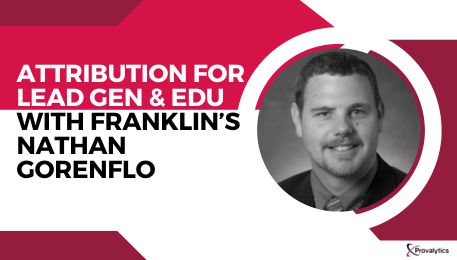
Attribution For Lead Gen & Edu With Franklin’s Nathan Gorenflo

Attribution For Lead Gen & Edu With Franklin’s Nathan Gorenflo

As the digital marketing landscape continues to evolve, the importance of attribution in measuring the success of marketing efforts cannot be overstated. Attribution provides insights into which touchpoints in the customer journey are driving conversions, allowing marketers to optimize their strategies and allocate resources effectively. In a podcast interview, Nathan Gorenflo, the Executive Director of Marketing &  Strategy and Marketing Operations at Franklin University, shared his experience in operationalizing attribution at the institution, providing valuable lessons for marketers looking to adopt this technology.

Nathan’s journey in measurement and digital marketing started in the early days of the industry, when he was a programmer at an agency before the birth of digital marketing. Over the years, he has worked with various brands, including Wells Fargo and Cardinal Health, before joining Franklin University nine years ago. At that time, the university was just beginning to embrace digital marketing as a whole, and Nathan’s department was primarily focused on using Google Analytics, which he described as a fairly limited tool.

However, with the advent of attribution, Nathan’s approach to measurement at Franklin University underwent a significant transformation. He emphasized the importance of understanding the entire customer journey and filling the sales funnel with relevant touchpoints. This involved moving beyond last-click attribution and looking at the full spectrum of touchpoints that contribute to conversions. Nathan shared that his biggest attribution “Aha!” moment was realizing the need for multiple independent resources to gain confidence in the picture being presented by vendors’ reporting. This highlights the importance of validating attribution data from different sources to ensure accuracy and reliability.

Nathan also discussed the challenges of operationalizing new technology, such as attribution, within an organization. He highlighted the need for buy-in from stakeholders, proper training and education for team members, and continuous optimization of processes. Implementing attribution successfully requires a strategic approach, and Nathan emphasized the importance of patience and incremental progress rather than attempting to swallow the entire attribution camel all at once.

Attribution For Lead Gen & Edu With Franklin’s Nathan Gorenflo

Looking ahead, Nathan expressed optimism about the future of attribution. He sees it evolving into a more sophisticated and comprehensive tool that goes beyond digital touchpoints and incorporates offline channels as well. He also shared his unique insight into the relationship between branding and direct response, emphasizing the need for marketers to understand how these two aspects fit together in driving conversions.

Gorenflo’s experience at Franklin University provides valuable lessons for marketers looking to operationalize attribution in their organizations. It underscores the importance of understanding the entire customer journey, validating attribution data from multiple sources, and taking a strategic and incremental approach to implementation. As the digital marketing landscape continues to evolve, attribution is poised to play an increasingly crucial role in measuring marketing success and optimizing strategies. Marketers can learn from Nathan’s insights and apply them to their own efforts to stay ahead in the ever-changing world of digital marketing.

The Creative Roots of Multi-Touch Attribution With Publicis Rudy Grahn

Attribution With Publicis’ Rudy Grahn

As the world of advertising continues to evolve, one concept that has gained significant attention in recent years is attribution. Attribution, or the process of determining the effectiveness of different marketing channels and touchpoints in driving consumer actions, has become a crucial tool for marketers to optimize their campaigns and allocate their resources effectively. However, despite its growing importance, attribution is still a relatively complex and often misunderstood concept for many organizations. In an interview Rudy Grahn, former EVP of Data Sciences at Publicis, shared his insights on the current state of attribution, its challenges, and its future potential.

Grahn is a seasoned veteran in the world of interactive advertising, with nearly three decades of experience. He has worked with major brands such as Wells Fargo, PwC, and Toyota, and has been at the forefront of the attribution revolution. In the podcast, Rudy discusses his journey from talk radio to copywriting, to becoming a leading expert in measurement and attribution.

One of the key takeaways from Rudy’s insights is the shifting power dynamics towards the consumer. He emphasizes that demographics and psychographics are not always accurate predictors of consumer behavior, and historical behavior is a better indicator. He also notes that consumers do not want ads, and this realization has fueled his interest in measurement and attribution. Rudy believes that the focus should be on delivering impactful ads with less frequency, rather than bombarding consumers with irrelevant messages.

When asked about the challenges of attribution adoption, Rudy points out that advertising is still fundamentally a black box. Despite significant progress in recent years, there is still a long way to go in understanding the true impact of different marketing channels and touchpoints. Rudy also highlights the importance of consumer-brand dialogue in attribution, as it opens up new possibilities beyond the traditional “last click” model.

Another interesting point discussed in the podcast is the role of attribution as a finance tool. Rudy challenges the perception that attribution is purely a mathematical exercise, and argues that it is not just about crunching numbers, but also requires creativity and strategic thinking. He also expresses surprise at the lack of standards for measuring offline creative impact, and the implications of the “first exposure” rule of thumb in attribution models.

The Creative Roots of Multi-Touch Attribution With Publicis Rudy Grahn

In terms of the future of attribution, Rudy sees great potential, but also acknowledges the pitfalls. He believes that attribution will continue to play a crucial role in optimizing marketing strategies and driving better results for businesses. However, he also points out that the adoption of attribution can be arduous, and organizations need to overcome challenges such as data privacy concerns, technology limitations, and internal resistance to change.

Rudy also discusses the idea of a Chief Attribution Officer (CAO) and sees no reason why this role should not exist in organizations. He emphasizes the need for dedicated leadership and expertise in the field of attribution to drive its adoption and implementation. He also suggests that for public companies, mandatory implementation of multi-touch attribution (MTA) can provide a complete accounting of all marketing expenditures and ensure transparency.

Grahn’s insights on attribution in the podcast shed light on the current state of the field, its challenges, and its future potential. Attribution is a powerful tool for marketers to optimize their campaigns and drive better results, but it also requires strategic thinking, creativity, and leadership. As the advertising landscape continues to evolve, organizations need to embrace attribution as a vital component of their marketing strategies to stay ahead in the competitive landscape.


Multi Touch Attribution Meets The 400 Million Dollar Marketer

AI-Driven Attribution Meets The $400 Million Dollar Marketer

TLDR: Anthony Pitts, the former VP of acquisitions at DraftKings, shares his insights on digital marketing success, emphasizing the importance of establishing a process-driven approach, data analysis, tracking, testing, and understanding timing. He highlights the significance of accurate attribution of conversions to specific channels, and the need to invest in knowledge and testing to optimize results. Pitts sees attribution heading towards a more precise picture through a mix of different data sources. His customized attribution framework and commitment to data-driven decision-making continue to shape the industry.

In the world of digital marketing, success hinges on understanding the effectiveness of different advertising channels and optimizing them for maximum return on investment. Anthony Pitts, also known as the “$400 million dollar marketer,” is a master of this art. As the former VP of acquisitions at DraftKings, Pitts played a pivotal role in the company’s incredible growth from 651 paying customers to over 2 million in just four years. In a podcast interview with the CEO of Provalytics, Pitts shared his insights on building a customized attribution framework and why committing to a process is more important than the outcome.

Pitts started his career with a Bachelor’s degree in Economics from Carnegie Mellon and later completed a Master’s in Political Science at the University of Rochester. He has a strong statistical background and a deep understanding of the qualitative drivers of human decision-making. Pitts believes that establishing a process and tracking data are critical components of effective marketing strategies.

One of the key takeaways from Pitts’ interview is the importance of establishing a process. He emphasized the need to have a structured approach to marketing that involves data analysis and performance reviews. Pitts shared how he used estimates and data analysis to determine which channels would receive the most budget allocation. For example, TV was given a higher budget allocation because it had a broader impact compared to other marketing channels. This allowed for subsequent evaluation and adjustments based on performance, leading to better decision-making.

Another important aspect of Pitts’ approach is tracking data. He highlighted the significance of identifying the first point of conversion, which for DraftKings was obtaining an email address. Each channel was assigned a unique promo code to track the original conversion channel throughout the customer’s journey. This allowed for accurate attribution of conversions to specific channels and enabled data-driven optimization.

Timing is also a critical factor in Pitts’ strategy. He emphasized the need to understand the seasonal components of a business and adjust marketing efforts accordingly. Different businesses have their own rhythm in terms of customer acquisition, and aligning marketing activities with these patterns can greatly impact results.

Multi Touch Attribution Meets The 400 Million Dollar Marketer

Pitts also addressed the decreasing popularity of testing among marketers. He emphasized the importance of testing and experimentation in marketing strategies and encouraged marketers to continue testing different approaches to optimize results. He also highlighted the need to invest in knowledge, especially when dealing with new channels or platforms, to overcome the learning curve.

When it comes to measurement and multi-touch attribution (MTA), Pitts believes it should be treated as an infrastructure functionality rather than a separate spending class from media. He emphasized the importance of spending as little as possible to achieve desired goals, unless there is a learning curve that requires additional investment in knowledge.

Looking into the future, Pitts sees MTA heading towards a more precise picture through a mix of different data sources. He acknowledged that while there may not be absolute truth in marketing, leveraging multiple data sources can provide increasingly accurate insights.

Pitts’ success at DraftKings can be attributed to his customized attribution framework and commitment to a process-driven approach. His emphasis on data analysis, tracking, testing, and understanding timing provides valuable insights for marketers looking to optimize their strategies. As the marketing landscape continues to evolve, Pitts’ expertise in multi-touch attribution and data-driven decision-making will undoubtedly continue to shape the industry.

Attribution Discovery & Secrets To Scaling Your Digital Marketing with Vanessa Branco

Attribution & Secrets To Scaling with Vanessa Branco

As the digital advertising landscape continues to evolve, understanding the impact and effectiveness of advertising efforts is crucial for businesses looking to optimize their marketing strategies. In a recent episode of the Forbes podcast, digital marketing expert Vanessa Branco shares her insights on the power of advertising attribution and how it can significantly impact a company’s return on investment (ROI).

With over 15 years of experience working with startups, Fortune 100 companies, and publicly traded companies, Vanessa Branco is a seasoned professional in digital branding and marketing, media optimization, performance-based marketing, and customer retention. She currently serves as the Vice President of Business Development for a white label trading desk and runs her own digital consultancy, VersaNine, providing hands-on expertise to brands looking to in-house their media buying.

During the podcast episode, Branco shares her journey in the digital advertising industry, starting as an Advertising Manager for a publicly-traded company that was advertising in-house and operating sites including screensavers.com. She highlights the evolution of advertising methods and priorities, which have remained consistent in acquiring customers, driving revenue, and increasing ROI, but have diversified in their approach.

Branco emphasizes the importance of attribution in digital advertising, citing her experience at screensavers.com where manual reporting and a constant need to acquire new customers led her to start slow and gradually adopt attribution. She also reminisces about the early days of affiliate networks, pixels, and the “Halo effect” – a term used to describe the positive impact of digital advertising on other marketing channels.

Attribution Discovery & Secrets To Scaling Your Digital Marketing with Vanessa Branco

Branco shares anecdotes from her experience in the industry, including her early efforts to prove that display advertising worked during the MySpace era, and the challenges of over-counting and inaccurate reporting. She highlights the game-changing impact of attribution in providing accurate insights into the performance of different creatives, affiliate programs, search terms, and vendors. By leveraging attribution, Branco explains how budget allocation can be optimized based on data-driven decision making.

One of the key takeaways from Branco’s insights is the importance of moving slowly and getting buy-in from stakeholders when implementing attribution. She emphasizes that it takes time, usually 3 to 6 months, to fully understand and leverage the power of attribution in a company’s marketing efforts.

Branco also shares how attribution can go beyond just tracking performance metrics, but also provide insights into the “why” behind a customer’s decision-making process, which can be invaluable for future campaigns. She advises on the optimal number of creatives to test simultaneously and provides recommendations on how long to test creatives for optimal results.

In conclusion, Branco’s expertise in advertising attribution shines through in this insightful podcast episode. Her experiences and anecdotes highlight the game-changing impact of attribution in digital advertising, providing businesses with data-driven insights to optimize their marketing strategies and improve ROI. As the digital landscape continues to evolve, leveraging attribution should be a priority for businesses looking to stay competitive and drive results in their advertising efforts.

Math The Frontier of Attribution with Havas Helia’s President Michael Kaushansky

Math: The Frontier of Attribution with Michael Kaushansky

In today’s rapidly evolving digital marketing landscape, the importance of accurate measurement and attribution cannot be overstated. Understanding the impact of marketing efforts on consumer behavior and sales is crucial for businesses to optimize their strategies and stay competitive in the marketplace. One of the leading experts in this field is Michael Kaushansky, former Chief Data Officer and President of Havas Helia and currently on the Decision Science team at Walmart Connect.  In a podcast interview, Michael shared his journey in the world of data analytics and measurement, and his vision for the future of attribution.

Michael’s career trajectory in measurement began with his passion for mathematics. With a bachelor’s degree in mathematics and a master’s in applied mathematics and operational research, he started his career at GE, Target, and GlaxoSmithKline, where he honed his skills in data analytics and business measurement. His breakthrough in digital advertising came after the 2008 financial crisis, when he realized the potential of data sets available on the World Wide Web for tracking ads, searches, and consumer behaviors.

In the podcast interview, Michael shared how he and his team of mathematicians at Havas Helia built what is now known as the path to purchase tracking. This innovative approach enables businesses to credit their marketing activities with their success rates in moving consumers through the sales funnel. By accurately attributing the impact of different marketing touchpoints, businesses can better allocate their budgets, make informed decisions in real-time, and optimize their marketing strategies.

Michael also discussed the importance of adapting to the digital world, where consumers are spending more and more time on their devices, even for brick-and-mortar purchases. Attribution in the digital space becomes imperative for businesses to understand the effectiveness of their offline marketing efforts and make data-driven decisions.

Math The Frontier of Attribution with Havas Helia’s President Michael Kaushansky

Despite the increasing importance of attribution in digital marketing, Michael highlighted three main barriers to adoption. First, the complexity of advanced analytics and attribution can be daunting for businesses that are not familiar with the intricacies of data analysis. Second, the lack of awareness and education about the benefits of attribution can hinder adoption. Lastly, the fear of failure and resistance to change can hold businesses back from embracing new measurement practices.

To overcome these barriers, Michael emphasized the need for businesses to be proactive in adopting advanced analytics and attribution. He encouraged advertisers and agencies to ask for sample data sets and test different attribution models to understand their effectiveness in their specific business contexts. He also highlighted the increasing adoption of attribution by big players in the industry and the progression of adoption typically seen for new practices.

Kaushansky is a pioneer in the field of digital marketing measurement. His expertise in data analytics and attribution has helped businesses optimize their marketing strategies and achieve better results. As the digital landscape continues to evolve, attribution will become even more critical for businesses to understand the impact of their marketing efforts and make data-driven decisions. Adapting to the digital world and embracing advanced analytics and attribution will be key for businesses to remain competitive in today’s dynamic marketing environment.

Attribution Adoptions Organizational Challenge with Kevin Seaman

Attribution Adoption’s Organizational Challenge with Kevin Seaman

Kevin Seaman, founder of Results Analytics, transformed Southern New Hampshire University (SNHU) from a TV-centric advertiser to a digital powerhouse using cross-channel multi-touch attribution. Through pilot tests and data-driven strategies, he successfully convinced decision-makers to diversify the marketing budget. Seaman faced challenges like convincing teams to adopt new technology and move budget items. He emphasizes the importance of organizational buy-in, the role of creativity in attribution, and human factors in driving success. His journey serves as a model for other marketers transitioning to a more data-driven approach.

Transforming from a TV-centric advertiser to a digital marketing powerhouse may seem like a daunting task, but Kevin Seaman, the Founder of Results Analytics and the VP of Performance Marketing at UAGC has done just that. In a podcast interview, Seaman shares his story of how he took a TV-centric organization and moved it into the digital space using cross-channel multi-touch attribution.

Seaman’s journey began in 2013 when he was working at Southern New-Hampshire University (SNHU). SNHU was looking to build its brand and drive growth in the online space on a national scale, but was exclusively spending on TV advertising. In order to convince decision-makers to fund a more diversified marketing mix, Seaman had to prove that digital was working. He ran numerous pilots in the digital space, testing different strategies and measuring their impact.

One of the challenges Seaman faced was the reliance on view-through measurement, which he refers to as the “blimp measurement.” He explains that this data point has shortcomings and unreliability, leading him to do large-scale placebo testing to identify a more reliable solution. He eventually convinced his marketing team to fund digital multi-channel, multi-touch attribution, a major milestone in his attribution journey.

Throughout his time at SNHU, Seaman constantly gathered proof of the success of his attribution strategy. He shares that getting people to adopt a new technology and move budget line items was the hardest part of the process. He faced organizational challenges and provides tips on how to overcome them, emphasizing the importance of organizational buy-in and communication.

Seaman also discusses the role of creative in attribution, highlighting the need for a balance between math and soft skills. He shares that in an organization, math alone will not sell attribution, and a different set of skills is required. He uses the example of Google to illustrate this point.

Attribution Adoptions Organizational Challenge with Kevin Seaman

Looking towards the future of attribution, Seaman discusses the non-measurable aspects of attribution, the possible fragmentation of attribution, and the impact of growing privacy concerns and vendor relationships. He also shares his insight that the people part of attribution is more difficult than the math, emphasizing the importance of human factors in implementing and optimizing attribution strategies.

Seaman’s story is one of transformation and success in the digital marketing space. Through his experience at SNHU, he navigated the challenges of adopting cross-channel multi-touch attribution and achieved significant results. His journey serves as a valuable lesson for marketers looking to transition from traditional advertising methods to a more data-driven, digital approach. As attribution continues to evolve and become more complex, Seaman’s insights on organizational buy-in, the role of creative, and the human factors involved in attribution are invaluable for marketers seeking to maximize outcomes and make analytics part of their DNA.

Overall, Kevin Seaman’s story is a testament to the power of data-driven marketing and the importance of constantly evolving strategies to adapt to the digital landscape. His achievements at SNHU demonstrate that with the right approach, it is possible to successfully transition from TV-centric advertising to a digital marketing powerhouse. As attribution continues to play a crucial role in marketing strategies, Seaman’s insights and experiences provide valuable lessons for marketers looking to drive growth and maximize outcomes in the ever-changing world of digital marketing.